Hunting Fishing Deer Bass Tumbler Wrap Review
As a designer who spends more time staring at stitch maps than most people spend watching TV, I approach every new machine embroidery design with a healthy dose of skepticism. We've all been there: you buy a file based on a pretty thumbnail, only to find out the satin stitches are too long, the density is a brick, or the details vanish once the needle hits the fabric. So, when I got my hands on the Hunting Fishing Deer Bass Tumbler Wrap, I didn't just look at the preview; I looked at the potential for real-world application.
First, let's address the elephant in the room regarding the product categorization. This asset is listed under Tumbler Wraps and described as a graphic with a 300 DPI resolution, intended to be sized to 9.3" x 8.2". For us embroidery purists, this immediately signals that we are looking at a high-resolution raster graphic meant for sublimation or print-and-cut applications, rather than a pre-digitized embroidery file with defined stitch types like satin stitch or fill stitch. However, in the modern craft business, lines blur. Many of us use these high-res graphics as the foundation for custom appliqué designs or as reference layers to create our own digitized versions for custom apparel. That is exactly how I approached this review: not just as a print file, but as a versatile design asset for the serious maker.
The Visual Personality and Mood
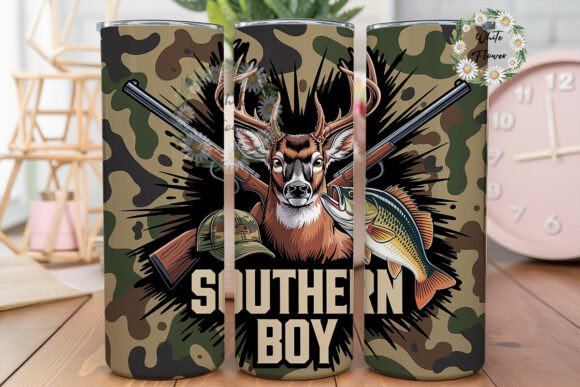
The first thing that strikes you about the Hunting Fishing Deer Bass Tumbler Wrap is its thematic cohesion. It captures that specific, rugged aesthetic that resonates deeply with outdoor enthusiasts. The layout balances the silhouette of a deer with the dynamic curve of a bass, creating a visual narrative that feels native to the hunting and fishing lifestyle. It isn't cluttered; it has breathing room. For an Etsy seller or small shop owner, this mood is gold. It speaks directly to a niche audience without screaming too loudly.
If you were to translate this graphic into an embroidery project, perhaps by using it as a template for a large-scale applique design on a heavy canvas tote or a workshop apron, the shapes are distinct enough to hold up well. The lack of tiny, intricate lettering or overly complex shading in the core motifs suggests that if digitized correctly, it would result in clean, bold stitching. The "straight" and "tapered" file options mentioned in the description hint at versatility for curved surfaces, which is crucial if you are adapting this for anything other than flat goods.
Real-World Application Scenarios
Let's move from theory to practice. Imagine a client comes to your craft business asking for a coordinated set of gifts for a father who loves the outdoors. They want something durable, personalized, and professional. While the original intent of the Hunting Fishing Deer Bass Tumbler Wrap might be for a sublimated tumbler, I see immense potential here for a mixed-media approach.
Picture a heavy-duty canvas tote bag design. You could print this graphic onto specialty fabric using the 300 DPI file, then outline the key elements—the antlers, the fish scales—with a thick, textured running stitch or a dense satin border. This hybrid technique elevates a simple print into a tactile handmade product. Alternatively, for a sweatshirt embroidery project, you could scale the design down significantly. At a smaller size, the deer and bass become iconic symbols rather than detailed illustrations, perfect for the left chest of a hoodie or the back yoke of a flannel shirt.
For those running boutique brands, consistency is key. Using this graphic across different mediums—sublimated tumblers for drinkware and embroidered patches for hats—creates a unified brand identity. The visual clarity of the design ensures that even when shrunk down for an embroidered patch, the subject matter remains instantly recognizable. This kind of adaptability increases the perceived value of your finished product and builds customer trust.
Technical Considerations and Fabric Challenges
Here is where we need to be realistic. Since this is fundamentally a high-resolution graphic intended for sizing in image editing software, you cannot simply load it into your embroidery machine and hit start. If you plan to use this for stitching, you must digitize it first or use it as an appliqué piece. This distinction is vital for maintaining quality.
If you choose the appliqué route, stitch density becomes less of a concern for the fill, but the perimeter stitching needs to be robust. On textured fabrics like terry cloth towels or rough canvas, ensure your stabilizer game is strong. A lightweight cut-away stabilizer is often insufficient for a design of this magnitude (9.3" x 8.2"); you will likely need a heavy-weight tear-away or a mesh cut-away to prevent puckering, especially on stretchy fabrics like jersey knits used in baby embroidery or t-shirts.
Be cautious with dark fabrics. While the graphic is free of watermarks and boasts high resolution, the color contrast in the original file might not translate well if you are tracing it for embroidery thread selection. Always test your thread colors against the fabric background. A dark green deer on a navy blue sweatshirt might look muddy unless you introduce a light-colored outline or backing to create separation. Similarly, if you are adapting this for curved surfaces like caps, remember that the "tapered" version of the file is essential to prevent distortion, but even then, large solid fills can cause registration issues on the stiff buckram of a hat front.
Maximizing Value for Your Shop
In the competitive landscape of online selling, presentation is everything. The Hunting Fishing Deer Bass Tumbler Wrap offers a fantastic opportunity for creating high-quality printable mockups. Because the resolution is 300 DPI, you can place this design onto product photos to show clients exactly what their personalized gift will look like before you ever stitch a single thread. This reduces hesitation and boosts conversion rates.
Furthermore, consider the seasonality. This design is a powerhouse for holiday embroidery projects during Father's Day, Christmas, or the opening of hunting season. By preparing these assets in advance, you can streamline your production workflow. However, always verify the licensing terms. Just because a file is watermark-free does not automatically grant commercial rights for unlimited sales. Confirm whether you can sell the physical stitched item or if there are restrictions on the number of units.
Final Designer Notes
Before committing to a full production run, treat this design with the respect it deserves. Start by printing a sample on scrap fabric to check the scale. Does the 9.3-inch width work for your intended hoop, or do you need to break the design into sections? If you are digitizing this for embroidery, pay close attention to the underlay. Large areas of fill require proper underlay stitching to anchor the top threads and prevent shifting during washing.
Inspect the small details. In a graphic this size, fine lines in the fish fins or the deer's fur might look crisp on screen but could turn into a bird's nest of thread if the stitch length is too short. Simplify where necessary. Remember, embroidery is an interpretation of art, not a perfect photocopy. Sometimes, reducing the detail actually enhances the durability and visual appeal of the small shop product.
Ultimately, the Hunting Fishing Deer Bass Tumbler Wrap is a versatile asset. Whether you use it strictly for sublimation on tumblers or as a creative springboard for complex commercial embroidery projects, its strength lies in its clear, evocative imagery. With the right preparation, proper stabilizers, and a keen eye for fabric compatibility, this design can become a staple in your catalog of design assets, helping you deliver professional, high-value items that your customers will cherish for years.