Mystic Forest House 20oz Tumbler Wrap Review
As a designer who spends more time staring at stitch simulations than most people care to admit, I approach every new digital embroidery file with a mix of curiosity and skepticism. We have all been there: you buy a stunning graphic, convert it, and realize halfway through the run that the density is too high for the fabric or the details are lost in the noise. Today, I am looking closely at the Mystic Forest House 20oz Tumbler Wrap. While the product listing categorizes this under Tumbler Wraps and Graphics, my eye immediately goes to how this translates from a high-resolution image into a tangible, stitched reality.
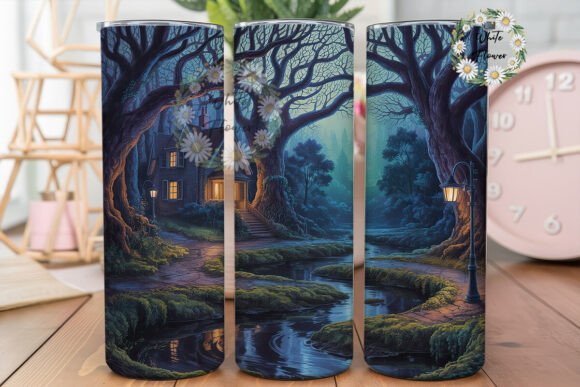
The first thing that strikes me about this design is its atmospheric mood. The concept of a "Mystic Forest" suggests deep greens, shadowy textures, and perhaps a touch of whimsical lighting around the house structure. The provided files require you to size the design to 9.3" x 8.2" using your own image editing software. This is a crucial detail. It means you are not just dragging and dropping a pre-sized raster; you have control over the final dimensions before digitizing or applying it. The fact that it comes in both Straight and Tapered versions shows an understanding of the physical form of a 20oz tumbler, which is excellent for sublimation or vinyl application. However, for us embroidery enthusiasts, this flexibility is a double-edged sword that requires careful planning.
Translating Graphics into Stitched Reality
Let's be honest: a 300 DPI graphic is fantastic for printing, but it is not a machine embroidery design out of the box. If you are an Etsy seller or a small shop owner looking to put this on a tote bag or a sweatshirt, you cannot simply hoop the fabric and hit start. You need to digitize this graphic or hire a professional to do so. When I visualize this specific forest house motif as an embroidery project, I see immense potential for texture play. The trees in the background could translate beautifully into varied fill stitch directions, creating depth without needing excessive thread counts. The house itself might benefit from a clean satin stitch border to define the architecture against the organic shapes of the foliage.
I recently imagined a scenario where a client wanted a custom personalized gift for a nature-loving friend. They wanted something that felt like a storybook illustration. Using the layout of the Mystic Forest House 20oz Tumbler Wrap as a reference, I would adapt this for a heavy canvas tote. The 9.3-inch width is substantial. On a standard tote, this would dominate the front panel, making a bold statement. For a craft business, this kind of visual impact drives sales. Customers love items that look like art rather than just a logo slapped on fabric.
Navigating Fabric and Hoop Challenges
Here is where practical experience matters. Because this design originates as a large graphic intended for a curved surface, adapting it to flat custom apparel requires attention to hoop size. A 9.3-inch wide design will likely exceed the capacity of a standard 5x7 hoop. You are looking at needing a large hoop, possibly 6x10 or even larger, depending on your machine. If you are working with a stretchy fabric like a jersey knit tee, stabilizing a design of this magnitude is non-negotiable. I would strongly recommend a cut-away stabilizer rather than tear-away. The weight of the stitching required to capture the "mystic" details of the forest could cause lightweight fabrics to pucker or distort over time if the foundation isn't solid.
Furthermore, consider the fabric texture. If you attempt this on a textured towel or a waffle-weave apron, the fine details of the forest scene might get lost. The stitch density needs to be managed carefully. In the original graphic, shadows are created by color gradients. In embroidery, we create shadows with thread layering. If the density is too high in the dark forest areas, the thread can become brittle and snap during washing. Conversely, if it is too light, the fabric underneath will show through, ruining the illusion of a dense, mysterious wood.
Commercial Viability and Product Value
For those running a small shop product line, the versatility of this motif is its strongest asset. While the source file is marketed for tumblers, the imagery screams "home decor." Imagine this adapted into an embroidered patch for a denim jacket or a backpack. The rectangular nature of the 9.3" x 8.2" ratio fits well on the back yoke of a jacket or the center of a pillow cover.
When evaluating the finished product potential, think about your target audience. Is this for holiday embroidery? Absolutely. The cozy cabin vibe fits perfectly with winter gift guides. Is it suitable for baby embroidery? Only if simplified. A full-detail forest scene might be too busy for a onesie, but isolating just the house element could create a charming nursery accent. The key is adaptation. Do not try to force the entire 300 DPI complexity onto a tiny cap. Instead, use the design assets as a library of elements.
From a branding perspective, consistency is key. If you sell printable mockups or digital previews, ensure that the embroidered version matches the expectation set by the graphic. The "Straight" and "Tapered" files mentioned in the description are useful for visualizing how the design wraps, but remember that embroidery is inherently flat. You lose the curvature effect unless you are doing complex 3D puff work, which might not suit this specific artistic style.
Essential Designer Notes for Execution
Before you commit to a production run or list this as a commercial embroidery item, follow these practical steps:
- Test on Scrap First: Never skip this. Stitch the design on the exact same fabric and stabilizer combination you plan to use for the final sale. Check for puckering and registration issues.
- Thread Color Contrast: The "mystic" feel relies on subtle tonal shifts. Ensure your thread chart has enough variation in greens and browns to prevent the design from looking flat.
- Check Licensing: The description notes the file is free of watermarks, but always confirm the license terms regarding commercial use. Can you sell the stitched item? Can you resell the digitized file? Clarity here protects your craft business.
- Mockup in Black and White: Convert your preview to grayscale. If the design loses its definition in black and white, your stitch placement might need adjustment to ensure clarity.
- Consider the Wash: Products like kitchen towels or aprons undergo frequent washing. Ensure your satin stitches are not too long, as they are prone to snagging.
In conclusion, the Mystic Forest House 20oz Tumbler Wrap offers a rich visual foundation that, with the right technical translation, can elevate a range of handmade products. It is not just a tumbler graphic; it is a versatile motif waiting to be reimagined through needle and thread. Whether you are creating a wedding gift, stocking an online boutique, or making a personalized gift for a loved one, the success lies in respecting the limitations of the medium while leveraging the artistic strength of the original design. Treat it as a starting point for creativity, not a rigid template, and you will find it adds significant value to your portfolio.