Watercolor Teacher Tumbler Wrap: A Designer's Review
As a designer who spends more time staring at stitch maps than most people care to admit, I approach every new digital embroidery file with a mix of excitement and skepticism. We have all been there: you buy a beautiful graphic, digitize it (or download a pre-made version), and realize halfway through the run that the details are too tight for the fabric or the color transitions look muddy in thread. Today, I am breaking down the Watercolor Teacher 20oz Tumbler Wrap PNG. While this asset is marketed primarily for sublimation on Tumbler Wraps, my interest lies in its potential adaptation for physical textile projects. Can a high-resolution watercolor graphic translate into a stunning handmade product like a tote bag or sweatshirt? Let's dig into the practical realities.
First Impressions: Mood and Visual Personality
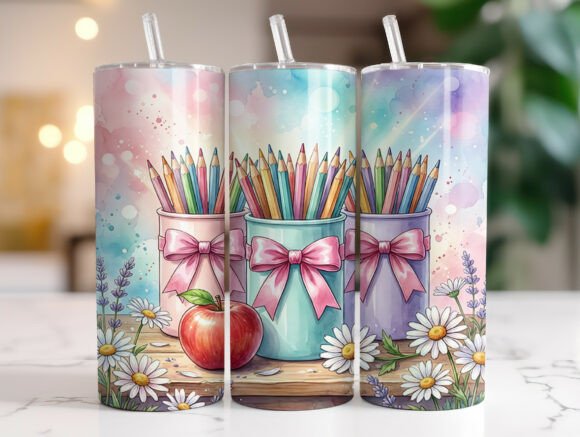
The moment you open the file, the first thing that strikes you is the resolution. At 300 DPI with dimensions of 9.3″ x 8.2″, this is not a pixelated afterthought; it is a robust design asset. The "watercolor" aesthetic suggests softness, blending, and an organic feel, which is perfect for the education theme. Teachers often appreciate designs that feel artistic rather than rigid or corporate. The layout is clearly intended to wrap around a curved surface, but when flattened for a rectangular embroidery project, it offers a generous canvas.
The visual personality here is warm and inviting. It avoids the harsh lines of vector clipart, opting instead for those gentle bleeds of color that mimic real paint on paper. For an Etsy seller or boutique owner, this mood is crucial. It signals quality and thoughtfulness. However, from an embroidery standpoint, watercolor effects are notoriously difficult to replicate with thread. Unlike a solid block of color, watercolor relies on transparency and gradient. If you are planning to use this as a reference for a custom digitization job, you need to be prepared to make some executive decisions about how to interpret those soft edges into satin stitch, fill stitch, or running stitch patterns.
Real-World Application: Beyond the Tumbler
Let's move away from the intended sublimation use case and imagine a real-life scenario. Picture a local elementary school looking for end-of-year gifts for their staff. They want something more substantial than a mug. You decide to create a limited run of canvas tote bag designs featuring this teacher motif. Because the file includes both straight and tapered versions, you have flexibility. The straight PNG is ideal for flat applications.
In this scenario, the Watercolor Teacher 20oz Tumbler Wrap PNG serves as the master reference. You would likely not embroider the entire 9-inch width unless you were working on a large blanket or wall hanging. Instead, you might scale it down for a sweatshirt embroidery pocket logo or a centered chest design on a teacher's cardigan. The detail level in the original graphic allows you to simplify certain areas while keeping the essence of the watercolor look. For a personalized gift, you could add the teacher's name below the graphic using a complementary font, ensuring the thread colors match the soft palette of the original image.
Another viable option is creating an embroidered patch. Patches are incredibly popular right now for custom apparel. By digitizing just the central icon or a cropped section of this wrap, you can create a wearable badge of honor for educators. This approach mitigates the risk of stitching too many details on stretchy fabric while still leveraging the beautiful artwork. Whether it is for holiday embroidery gifts or daily wear, the versatility of the source image is high, provided you respect the limitations of the medium.
Technical Challenges and Fabric Considerations
Here is where we need to be realistic. Translating a 300 DPI raster image into a machine embroidery design requires careful planning. Watercolor effects rely on subtle shifts in hue that threads simply cannot replicate one-to-one. If you attempt to stitch every shade change, your stitch density will become excessive, leading to a stiff, cardboard-like finished product that no one wants to wear.
You must exercise caution with small hoop sizes. If you try to cram the full 9.3-inch width into a standard 4x4 hoop, you will lose the delicate gradients that make this design special. Furthermore, textured fabrics like Terry cloth or heavy canvas can eat up fine details. On dark fabric, the lighter watercolor tones might vanish unless you utilize a dense underlay or even consider an applique design approach where the background fabric provides the base color. For stretchy fabrics like jersey knits used in baby embroidery, large fill areas can cause puckering. In these cases, breaking up the design into smaller, disconnected elements or using a cut-away stabilizer is non-negotiable.
Curved surfaces present another hurdle. While the tapered PNG is great for printing on a tumbler, embroidery on a cap or a curved sleeve requires a different mindset. The distortion inherent in wrapping a flat design around a sphere means you should avoid placing critical text or tiny details near the edges of the design area. Always test your digitized version on a scrap piece of the actual fabric you intend to use. Check the contrast in black and white mockups to ensure the design holds its shape without relying solely on color.
Value, Trust, and Commercial Viability
For craft business owners, the perceived value of the final item hinges on execution. A sloppy stitch job on a beautiful design erodes customer trust. Conversely, a well-executed adaptation of the Watercolor Teacher 20oz Tumbler Wrap PNG can elevate your brand. It shows that you understand both art and technique. When customers see a clean, professional small shop product, they are more likely to return and recommend you to colleagues.
This design has strong potential for commercial embroidery projects, such as uniform branding for private schools or daycare centers. Consistency is key here. If you are producing fifty items, your digitizing settings must be locked down so that batch one looks identical to batch fifty. The high resolution of the source file helps immensely in this regard, giving you a clear target to aim for during the digitizing phase.
Designer Notes for Success
Before you commit to a full production run, keep these practical tips in mind:
- Test First: Always stitch out on scrap fabric identical to your final material. Check for pull and puckering.
- Check Licensing: Since this is a digital download intended for sublimation, verify the license terms before selling embroidered goods. Some creators allow personal use only, while others permit commercial application.
- Simplify for Thread: Do not try to copy the watercolor blend exactly. Group similar shades together to reduce thread changes and improve stitch clarity.
- Stabilizer Matters: Use the right stabilizer for the fabric weight. Heavy designs need strong support to maintain their shape after washing.
- Verify Dimensions: Ensure the scaled size fits your intended hoop and garment area without crowding seams or pockets.
In conclusion, the Watercolor Teacher 20oz Tumbler Wrap PNG is a high-quality graphic that offers more than just tumbler potential. With thoughtful digitizing and an understanding of textile limitations, it can become the centerpiece of a fantastic line of educator-focused goods. It is a reminder that great Graphics are the starting point, but the designer's skill in translation is what creates a truly memorable handmade product.