Review: Red White Blue Floral Jar 20oz Tumbler Design
As a designer who spends more time staring at stitch simulations than most people care to admit, I approach every new digital embroidery file with a mix of curiosity and skepticism. When I first pulled up the Red White Blue Floral Jar 20oz Tumbler graphic, my initial reaction wasn't about the patriotic theme itself—though that is always a strong seller—but rather about the composition and how it translates from a flat screen to a textured surface. This isn't just a pretty picture; it is a set of design assets intended for real-world application, specifically targeting the booming market of custom drinkware and coordinated merchandise.
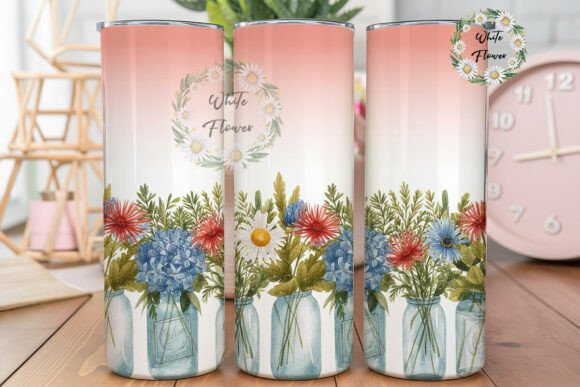
The visual personality of this piece strikes a balance between rustic charm and crisp modernity. The "jar" motif suggests a mason jar aesthetic, which pairs beautifully with floral elements, while the red, white, and blue palette immediately flags it as a powerhouse for holiday embroidery. However, before you commit this to your hoop, we need to talk about how this graphic behaves when you are actually running a machine embroidery design or applying it as a sublimation wrap.
First Impressions and Mood
The layout feels intentional. Unlike some cluttered graphics where flowers fight for attention against bold text, this design seems to offer breathing room. The mood is celebratory yet grounded. It evokes images of summer picnics, Fourth of July parades, and boutique farmhouse decor. For an Etsy seller or small shop owner, this kind of emotional resonance is gold. It tells a story before the customer even reads the product description.
One critical detail noted in the specs is the resolution. At 300 DPI, the source file is sharp. This matters immensely if you are using this as a printable mockup for your online listings or if you are digitizing elements of it into an applique design. A low-resolution image pixelates when enlarged, ruining the professional look of your finished product. With this high-res base, you have the flexibility to scale without losing definition, provided you respect the aspect ratio.
Real-World Application Scenarios
Let's move beyond theory and imagine a real project. Suppose you are preparing a custom order for a local boutique that wants a coordinated line of summer goods. They ask for a tote bag design and matching tumblers. Here is where the Red White Blue Floral Jar 20oz Tumbler shines. The package includes two distinct files: one straight and one tapered. This is a crucial distinction often overlooked by beginners.
If you are creating a sweatshirt embroidery piece or a flat embroidered patch, the straight file is your go-to. It ensures that when stitched onto a flat plane like a tote bag canvas or a pillow cover, the proportions remain accurate. However, the tapered file is engineered specifically for the curvature of a 20oz tumbler. If you try to force the straight file onto a curved cup, the design will look distorted once applied. Having both options in one download saves you the headache of manually warping images in your editing software.
Consider a scenario involving baby embroidery. While the patriotic theme is great for a "Baby's First Fourth" outfit, you must be mindful of the scale. The design dimensions are listed at approximately 9.3" x 8.2". That is quite large for a baby onesie. In this case, you would need to size the design down significantly in your image editing software. Always check how the stitch density holds up when you shrink a large graphic; fine details in the floral petals might merge together if reduced too much.
Technical Considerations for Stitching
For those planning to digitize this graphic into a stitch file, or for those using it as a reference for hand-stitched details, pay close attention to the color transitions. The red, white, and blue scheme offers high contrast, which is excellent for visibility. However, white thread on light fabric can disappear, and dense blue areas on dark navy fabric might lack definition. I strongly recommend testing your thread colors against your chosen fabric texture.
If you are converting this into a satin stitch border or using fill stitch for the jar body, remember that large fill areas can cause fabric puckering if not properly stabilized. Since this design is likely to be used on items that get washed frequently—like kitchen towels or aprons—using a cut-away stabilizer is non-negotiable. Tear-away stabilizers might leave edges that irritate the skin or degrade after multiple wash cycles.
Also, note that the design is not seamless. This means you cannot tile it across a large blanket without seeing visible breaks or edges. It is designed as a standalone focal point. This works perfectly for a centered chest logo on a cap or a main panel on a tote, but it limits its use for all-over prints.
Navigating Fabric and Hoop Challenges
Size matters. With dimensions over 9 inches, this design demands a large hoop size. If your machine only supports a 5x7 hoop, you will have to split the design, which requires advanced software skills to realign perfectly. For most hobbyists, this design is best suited for machines with jumbo hoops or for projects where the design can be applied as a transfer rather than stitched in one go.
Be cautious with stretchy fabrics. Applying a large, dense graphic to a thin t-shirt can cause the garment to warp. The weight of the threads pulls on the knit fibers. For custom apparel, stick to heavier cotton blends or use the design on structured items like caps or bags where the fabric has less give. If you are working on a curved surface like a hat, the tapered version of the file is essential, but even then, verify that the floral details don't get lost in the curve of the brim.
Maximizing Commercial Value
From a business perspective, the Red White Blue Floral Jar 20oz Tumbler is a versatile asset. It fits neatly into the craft business model of selling seasonal goods. Because the design is free of watermarks and high resolution, it serves as an excellent base for creating marketing materials. You can generate realistic printable mockups to showcase on your website before you even stitch a single thread.
Customer trust is built on consistency. If your listing shows a crisp, vibrant design but the delivered item looks blurry or misaligned, you lose credibility. By utilizing the correct tapered file for tumblers and the straight file for flat goods, you ensure that the handmade product matches the digital promise. This attention to detail separates professional commercial embroidery operations from casual hobbyists.
Final Designer Notes
Before you launch this into production, take these practical steps:
- Test on Scraps: Never run a new design on your final garment first. Stitch it on a scrap piece of the same fabric to check for puckering or thread breaks.
- Check Licensing: While the file is high quality, always confirm the specific license terms regarding commercial use. Can you sell the stitched item? Can you resell the digital file? Clarity here protects your business.
- Contrast Check: View your design in black and white on your screen. If the details vanish in grayscale, they might get lost in the stitching too. Adjust your thread choices accordingly.
- Sizing Verification: Use your image editing software to resize the 9.3" x 8.2" image to fit your specific hoop or product constraints while maintaining the 300 DPI quality.
In conclusion, the Red White Blue Floral Jar 20oz Tumbler is a robust, well-thought-out graphic that bridges the gap between digital art and tactile craft. Whether you are making a personalized gift for a family member or stocking inventory for a holiday craft fair, this design offers the flexibility and visual appeal needed to succeed. Just respect the technical requirements of sizing and stabilization, and you will end up with a finished product that stands out in a crowded market.